

No items found.
Resources
July 9, 2026
Self-Management of Hip Pain
Improve your hip function by relieving pain and improving range of motion with this self-management sequence developed by Jonathan Reynolds PT, PhD, inventor of TolaPoint.

Jonathan Reynolds, PT, PhD
Improve your hip function by relieving pain and improving range of motion with this self-management sequence developed by Jonathan Reynolds PT, PhD, inventor of TolaPoint.
Check with your health-professional or physical therapist before you attempt this self-management sequence.
Part 1: Prepare your joint for mobilization
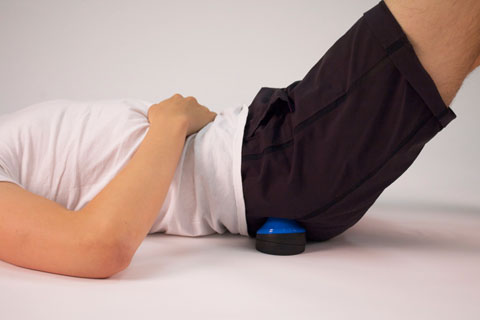
With your TolaPoint, target the myofascia of your gluteal muscles, hamstrings, and hip flexors. If you have painful trigger points in these areas, address these first. Then apply pressure to the middle of each of the muscles (where the muscle spindles are situated in their greatest number). Your therapist or chiropractor will be able to tell you which areas to target if you are not sure.
Step 1: Apply pressure to your gluteal area
Target your: gluteus medius, gluteus minimus, piriformis, and quadratus femoris.
Step 2: Apply pressure to your hamstrings
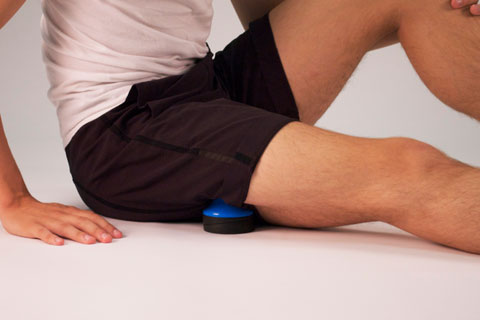
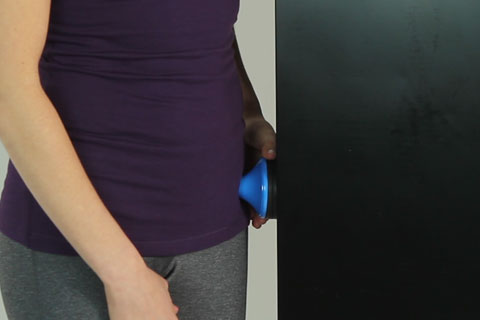
Step 3: Apply pressure to the hip flexors
Target your: tensor fascia lata, psoas, iliacus, sartorius, and rectus femoris.
Part 2: Mobilization of your joint
Only perform these mobilizations with the approval of your physical therapist or chiropractor. Stop if you feel pain. Always use only gentle distraction force when performing these techniques. Do not perform these mobilizations if you:
- have osteoporosis or osteopenia,
- have hemophilia (blood clotting disorder that often results in bleeding into joints),
- have had a hip joint replacement,
- have a fracture (including a stress fracture and stress reaction) in your pelvis, femur, lower leg, foot or ankle,
- have cancer (especially bone or pelvic organ (testicular, ovarian, uterine, anal, etc.) cancer), or
- are receiving chemotherapy or radiation therapy.
If you have to lock the door, be sure that the door can be unlocked by someone else should you become incapacitated.
Step 4: Longitudinal (axial) mobilization in hip neutral
Sit or lie back and move your body away from the door to tighten up the strap. Hike your hip as if trying to pull away from the door to feel a gentle pull on your hip. Alternatively, you can push your body away from the door with a kicking action of the unaffected leg. Oscillate back and forth approximately twice per second for 1 minute.
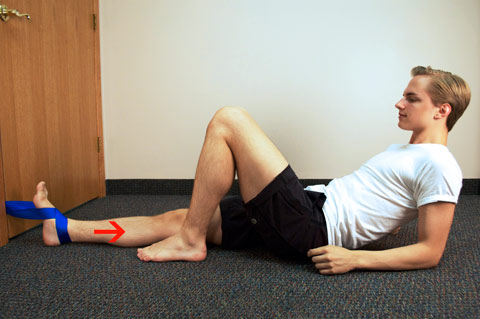
You should feel a gentle distraction of your hip. STOP if you feel pain.
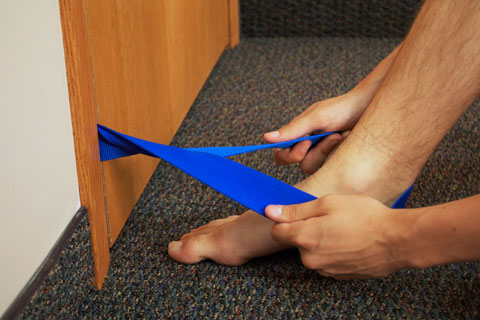
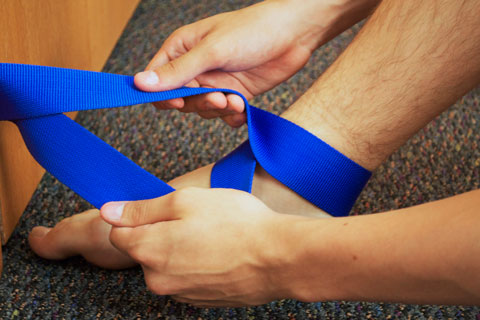
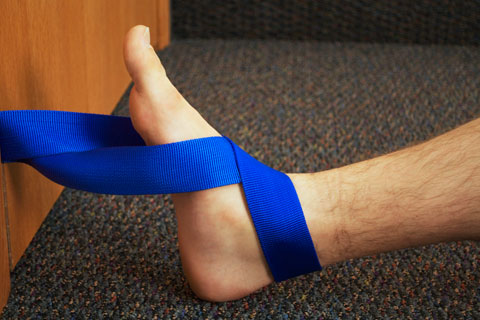
To secure your foot for this mobilization
Close the buckle of your Strap. Place the buckle on the other side of a door. Close the door securely.
Place your foot through the loop in your Strap with the Strap around around the back of your ankle.
Cross the straps over one-another.
Raise your toes to point them through the loop you created in the previous step.
Step 5a: Lateral distraction sitting
Position your Strap approximately 8” off the floor. Sit with the affected side leg through the loop in the Strap. Slide the strap loop as high up your thigh as possible. Bend the affected side knee and plant the foot on the floor. With the unaffected side hand, gently pull the affected side knee away from the door in an oscillatory fashion, two repetitions per second.
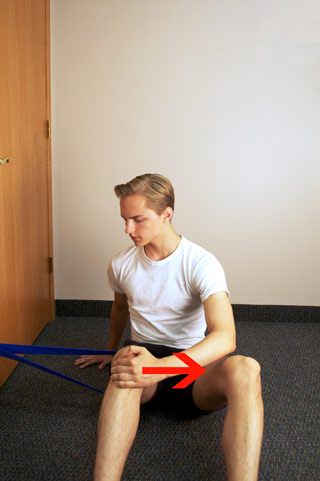
You should feel a gentle sideways distraction of your hip. STOP if you feel pain.
Step 5b: Lateral distraction standing
Position your Strap at upper thigh height. Stand with the affected side leg through the loop in the strap. Slide the strap loop as high up your thigh as possible. With the unaffected side hand against the wall, gently push your body away from the door in an oscillatory fashion, two repetitions per second.
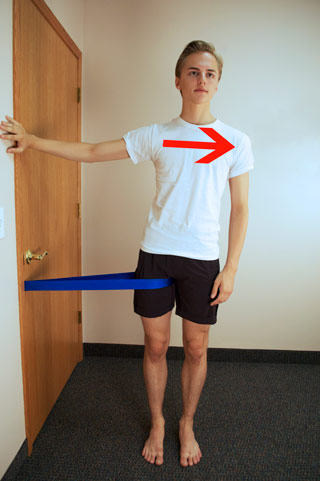
You should feel a gentle sideways distraction of your hip. STOP if you feel pain.
Step 6: Longitudinal distraction – non-axial
Position your Strap approximately 10” off the floor. Lie on your back with the affected side leg through the loop in the strap. Slide the strap loop as high up your thigh as possible. Bend your opposite side knee and slide your body as far away from the door as possible. Bend your affected side knee towards you and grasp around your knee with interlaced hands. Gently pull your knee towards you in an oscillatory fashion, two repetitions per second.
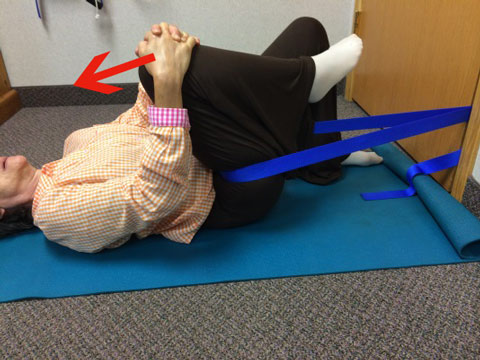
You should feel a gentle sideways distraction of your hip. STOP if you feel pain.
Step 7: Longitudinal distraction (axial) at 90° hip flexion
Secure your foot in the strap (see Step 4 above) keeping your affected side hip slightly off the floor. Relax your leg muscles, and slowly and gently lower your hip to the floor to create a feeling of distraction at the hip joint. Hold for 30 seconds, then stand to test your hip functionally. If it feels better, repeat as needed. Provided you don’t experience any pain, you can hold for up to 2 minutes at a time.
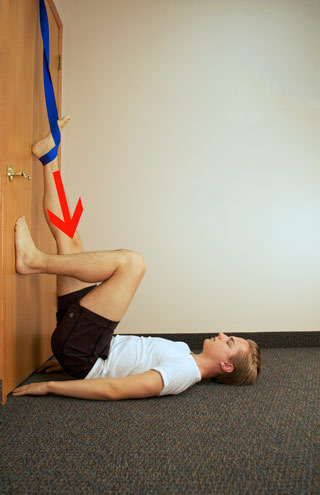
If it feels worse, or if you experience pain, STOP the technique.